
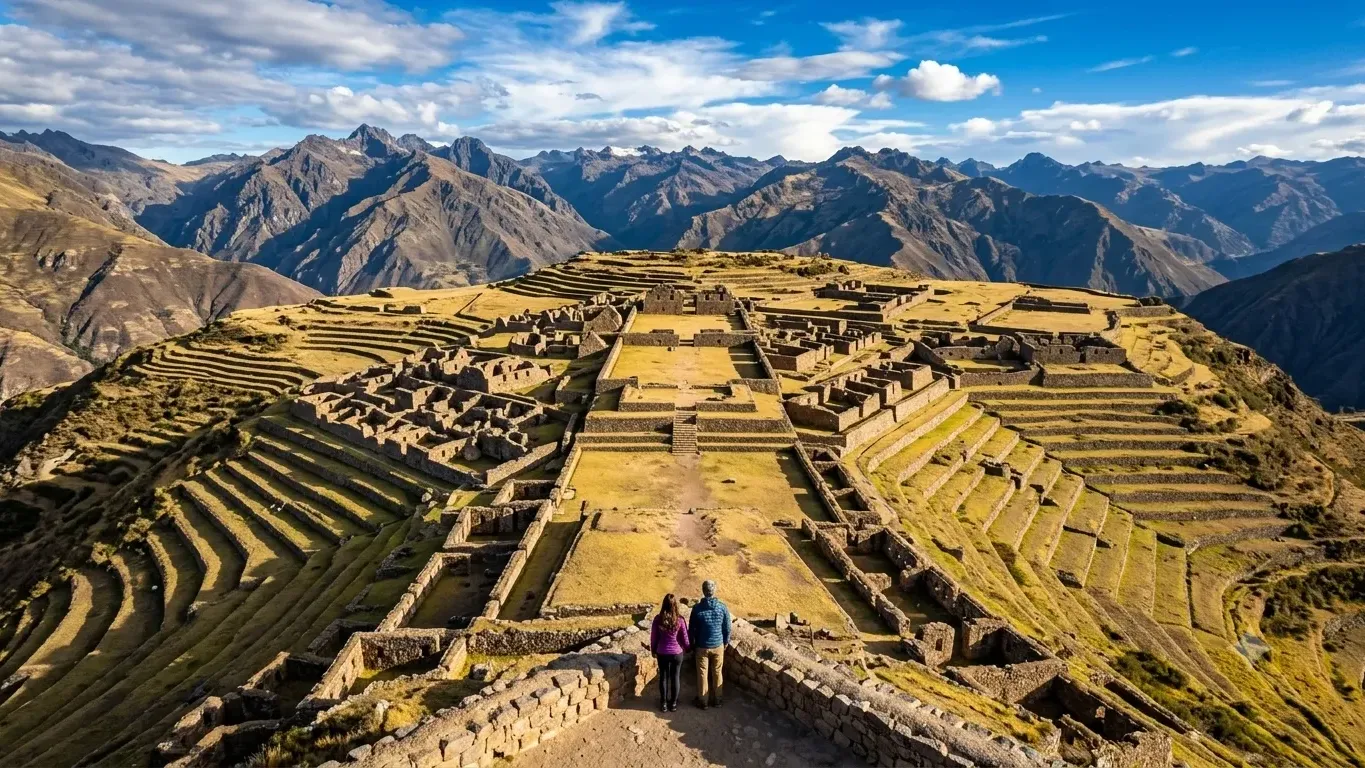
In 2026, a National Geographic feature put a name few travelers knew onto the world map: T'aqrachullo. Perched on a windswept mesa in the southern Andes, it has been called the Inca citadel that is bigger than Machu Picchu. The headline is irresistible, but the real story is more interesting than the slogan. Here is what T'aqrachullo actually is, why it matters and whether you can see it.
What is T'aqrachullo?
T'aqrachullo, also known as María Fortaleza, is an archaeological complex in the province of Espinar, in the south of the Cusco region, set on a plateau above the canyon of the Apurímac River at around 4,100 meters. It was not exactly "discovered" overnight: archaeologists had visited the site for decades, but only after the Ministry of Culture intensified excavations from 2019 did its true scale come to light. The complex shows occupation across different Andean periods, with structures linked to Wari, Qolla and Inca cultures.
Is it really bigger than Machu Picchu?
Yes and no, and the nuance matters. T'aqrachullo covers roughly 17.4 hectares with nearly 600 documented structures across several sectors. Machu Picchu's built core is closer to 4.3 hectares with around 200 structures. In pure area, T'aqrachullo is about four times larger. But specialists have been careful: this is not a size contest. Machu Picchu remains a masterpiece of Inca engineering and setting. What makes T'aqrachullo important is not that it "beats" Machu Picchu, but that it may help explain how sacred geography, elite ritual and political power came together in one high-Andean place.
The gold that changed everything
The turning point came when excavators found metal beneath the floor of a stone enclosure. In total, researchers recovered nearly 3,000 small ornaments of gold, silver and copper, dating to the early 16th century. These pieces may have adorned the ceremonial clothing of the Inca elite, a strong sign that T'aqrachullo was no secondary outpost but a place of real political, economic and religious weight in the Andean world.
Signs of a last stand: could it be Ancocagua?
Alongside the ornaments, archaeologists found something darker: stone projectiles, obsidian spearheads and skeletons with wound marks, evidence of violence and resistance. That fits an intriguing hypothesis. Several researchers now suspect T'aqrachullo could be Ancocagua, a sacred citadel named in colonial chronicles and tied to Inca rebellion after the Spanish conquest. The geography, the ceremonial evidence and the old descriptions appear to line up. Still, archaeologists are cautious: for now it is a strong hypothesis, not a closed case, and much of the site remains unexcavated.
Can you visit T'aqrachullo in 2026?
Yes, but it is an adventure, not a day trip. The Ministry of Culture opened the site to visitors in December 2024 after years of excavation and restoration. A few things to know before you go:
- Getting there: it is far from the classic tourist circuit. Plan on 4 to 5 hours by road from Cusco to Yauri (the capital of Espinar), then local or hired transport to the site.
- Altitude: at around 4,100 meters, this is serious elevation. Acclimatize in Cusco for at least two or three days first.
- Entry: admission has been free and without advance booking, though that may change as interest grows. A guide is not mandatory but is strongly recommended, given the scale and the altitude.
- Access is improving: regional authorities have announced road works to make the area easier to reach, which could eventually link Machu Picchu, T'aqrachullo and the Colca Canyon into a single southern route.
Because conditions at an emerging site change quickly, confirm current access, fees and opening hours before you travel.
T'aqrachullo or Machu Picchu?
For most travelers, this is not an either-or. Machu Picchu remains the accessible, unmissable icon of the Inca world, reachable by train and set just above the town of Aguas Calientes. T'aqrachullo is a remote, emerging site for the curious and the adventurous, best added by those with extra time and a taste for the road less traveled. If your trip centers on Machu Picchu, the smartest base is Aguas Calientes itself, at the foot of the mountain, where you can rise early and enter the citadel before the crowds. From there, the story of the Incas, old discoveries and new ones alike, feels close enough to touch.
Frequently asked questions
- What is T'aqrachullo? An Inca archaeological complex, also called María Fortaleza, in Espinar, Cusco, featured by National Geographic in 2026 for its scale and importance.
- Is T'aqrachullo really bigger than Machu Picchu? In area, yes: about 17.4 hectares versus roughly 4.3 hectares for Machu Picchu's core, around four times larger. But experts caution it is not a simple size contest; its value lies in what it reveals about the Inca world.
- Could T'aqrachullo be Ancocagua? Some researchers think so. The geography, ceremonial finds and colonial chronicles align with the sacred stronghold of Ancocagua, but it remains a hypothesis, not a confirmed identification.
- Can you visit T'aqrachullo? Yes. It opened to visitors in December 2024. It sits in Espinar, about 4 to 5 hours from Cusco via Yauri, at 4,100 meters, so acclimatization and a guide are strongly recommended. Confirm current access before traveling.
- Is T'aqrachullo near Machu Picchu? No. It is in the south of the Cusco region, far from Machu Picchu and the usual tourist circuit. The two are best planned as separate experiences.